Mentoring
- Community
- BFD Academy
- Risk Management
- The Trader Mindset
- Habits of a Professional Trader
- BFD System Training
- Live Training Sessions
The BFD Advanced Trading System
A rules-based system, the signals it generates on your charts from your own settings, and a training library that shows its work — including the tests we failed.
Get the free panel ↓
What you are joining
Most groups sell you the middle one on its own. It is the least useful piece by itself. A signal you cannot execute, size correctly, or put in context is not worth much — the three pieces work together or not at all.
The problem
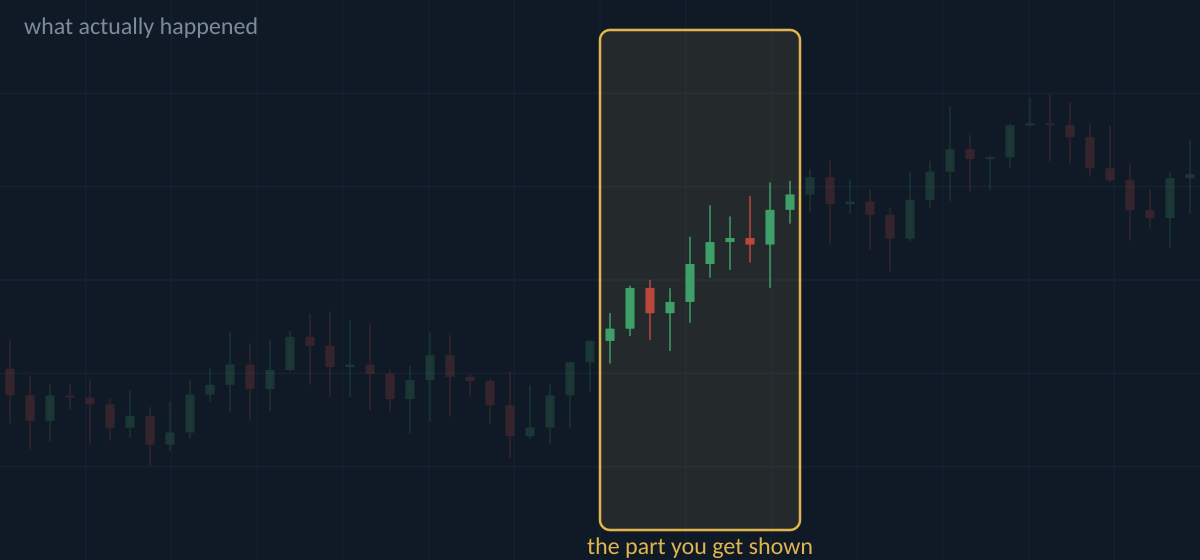
Winners get posted. Losers quietly do not.
You never see how many trades, over what period, with what costs, or what was thrown away.
Everything arrives with equal confidence, so you cannot tell tested from guessed.
We built this for our own accounts first. The evidence standard came from needing to trust it ourselves.
Our standard
Every claim has to hold in two separate year-long tests — one trending market, one quiet one. Wins in one and loses in the other is a rejection, not an average.
The hypothesis and the pass/fail line are recorded before the test runs. One change at a time. The goalposts cannot move afterwards.
Findings are re-run against thousands of shuffled versions of the same data, so a lucky streak does not get sold as an edge.
Rejected ideas are kept and published. Most of the research record is things that did not work.
Competitors can copy the words. The record is the part that takes two years.
Before you join
Said here rather than in small print at the bottom.
This is education. Nothing here is a recommendation to buy or sell anything, and nothing is tailored to your circumstances.
No income claim is made or implied. Testing results never guarantee future performance, and trading carries real risk of loss.
Signals are information. Every decision — whether to take it, at what size, and when to get out — stays yours.
The system has rules and the rules take work to learn. Anyone selling effortless is selling something else.
Full risk disclosure and terms are published separately and reviewed by counsel before any paid membership opens.
Pillar 01 — Mentoring
| Module | Lessons | What it covers | After |
|---|---|---|---|
| Start Here | 1 | The five golden rules, and the report-card metric that checks each one | — |
| Risk First | 5 | R as the only unit that travels, what one contract actually risks, size from the stop, what a trade costs, the daily loss limit | Van Tharp |
| The Mental Game, Measured | 7 | One lesson per principle of consistency — each tied to a number the report card already computes | Mark Douglas |
| Habits of a Professional | 7 | Pre-session, marking the day, the journal, when not to trade, the post-loss protocol, the weekly review | Brett Steenbarger |
Twenty lessons written so far, every idea credited to whoever had it. A lesson may only state as fact what the validation record supports — validated numbers are stated plainly, everything else is labelled, in the course material exactly as on the cards.
Pillar 02 — The BFD System / top-down analysis
One panel, plain English, live on the chart you are already trading.
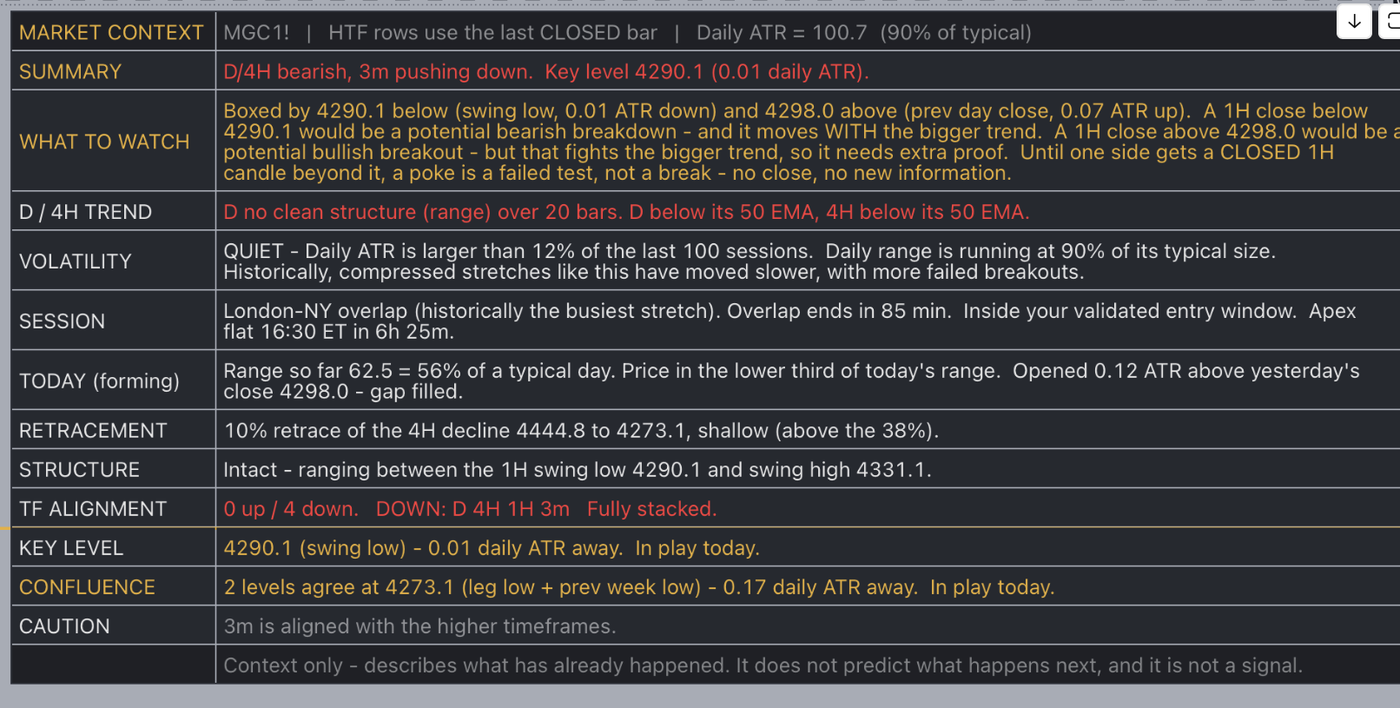
“A 1H close below 4290.1 would be a potential bearish breakdown — and it moves WITH the bigger trend.”
“Until one side gets a CLOSED 1H candle beyond it, a poke is a failed test, not a break — no close, no new information.”
“Context only — describes what has already happened. It does not predict what happens next, and it is not a signal.”
Live panel on MGC1! 3-minute. Every row is written from closed bars; the one forming value is labelled as forming.
Pillar 02 — four signal families
Same chart, same session. Hover the signal’s dot and the system shows its grading.
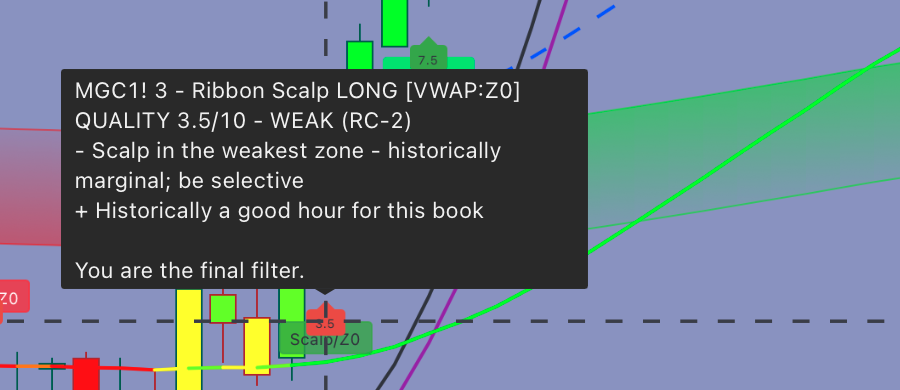
3.5 / 10 — WEAK
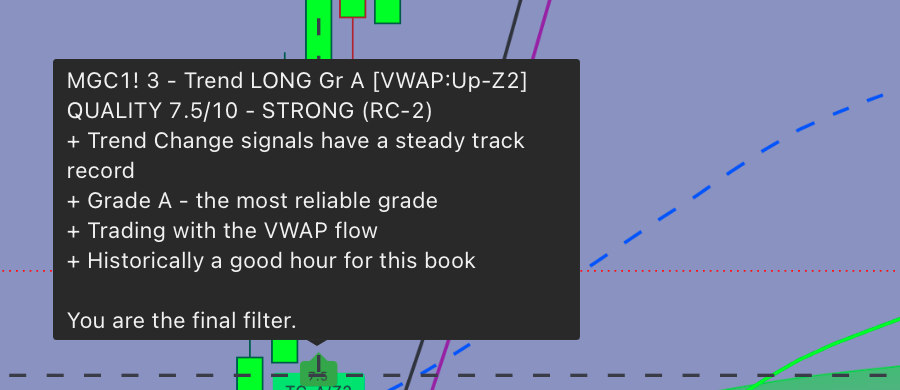
7.5 / 10 — STRONG
Both cards end with the same line: “You are the final filter.” The score puts the setup in a group — it is never an instruction and never a position size.
Pillar 03 — Your Report Card
Eighteen metrics — seven on performance, eleven on behaviour — each one computed for you and for the system side by side, with the feedback written from the gaps. What is working, and where it is costing you.
| Sample | Me | System |
|---|---|---|
| Win rate | 60% | 40% |
| Median winner | 0.1R | 0.7R |
| Expectancy | −0.15R | +0.20R |
Winning more often than the system and still losing money. The gap is not the signals — it is what happened after the entry.
Illustrative figures — shown to demonstrate the format, not anyone’s results.
What is good
Where you can improve
A sample report card, shown to demonstrate the format. Figures are illustrative and are not a record of anyone’s trading. The feedback itself is deterministic — the same rules every time, computed from your own numbers. No black box, and no flattery.
Our free gift
Free whether you ever pay us anything or not. No card, and no commitment.
Yours to add to any chart, on any instrument you trade. It runs on its own rules — nothing to configure.
What every row means, which three to read first, and the ones that are describing rather than suggesting.
Where the guide lands, and where the questions about reading the panel get answered.
One email with the panel, then occasional notes on what we tested. Unsubscribe any time.
Already know you want the room? The invite goes straight there.
The panel describes what has already happened. It does not predict what happens next, and it is not a signal — which is exactly why we can give it away.
The standing rule
The system’s job is to put honest evidence in front of you, and to label what it does not know. The decision is always yours — which is also why we will never tell you what to risk.
Mentoring, the system, and an honest report card. Start free.